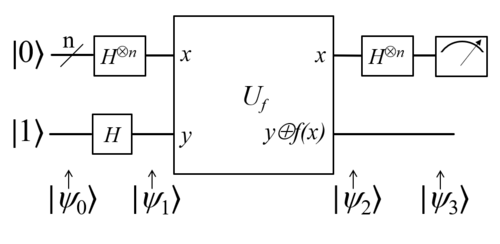
Quantum algorithms speed up certain computations that are very demanding on classical hardware.
The reason for this advantage lies in the computational space. At any time, the computational state of a classical hardware is a specific
configuration of the n bits, for instance 011001110, out of the 2^n total configurations.
Instead, in a quantum computer with n qubits, ... the state is a (amplitude-)distribution over such configurations.
So, the computational space is much bigger, enabling parallel manipulation of classically relevant states.
The trade-off is that quantum states are fragile and the read-out of the results is often a bottleneck.
For this reason, only a limited number of quantum algorithms has been shown to be really faster.
I'm currently working on an industrial project (under NDA) together with a consulting firm that aims at bringing one specific algorithm
more down to earth. Indeed, often industrial problems require a variant of a publicly-known algorithm.
Under which conditions -- number of qubits, type of algorithm (analogic or gate-based) and so on --
will this quantum algorithm show quantum advantage and outperform the known classical algorithms that are known for this problem?
Dissipative quantum systems
To a great extent, it is possible to study a classical systems in isolation, that is, without considering the effect of the environment.
Often friction and radiative losses can be neglected from the energy budget of the system.
This is not the case for quantum systems, where the interaction with the environment is typically strong... since the system energies
are as small as those related to the friction and losses.
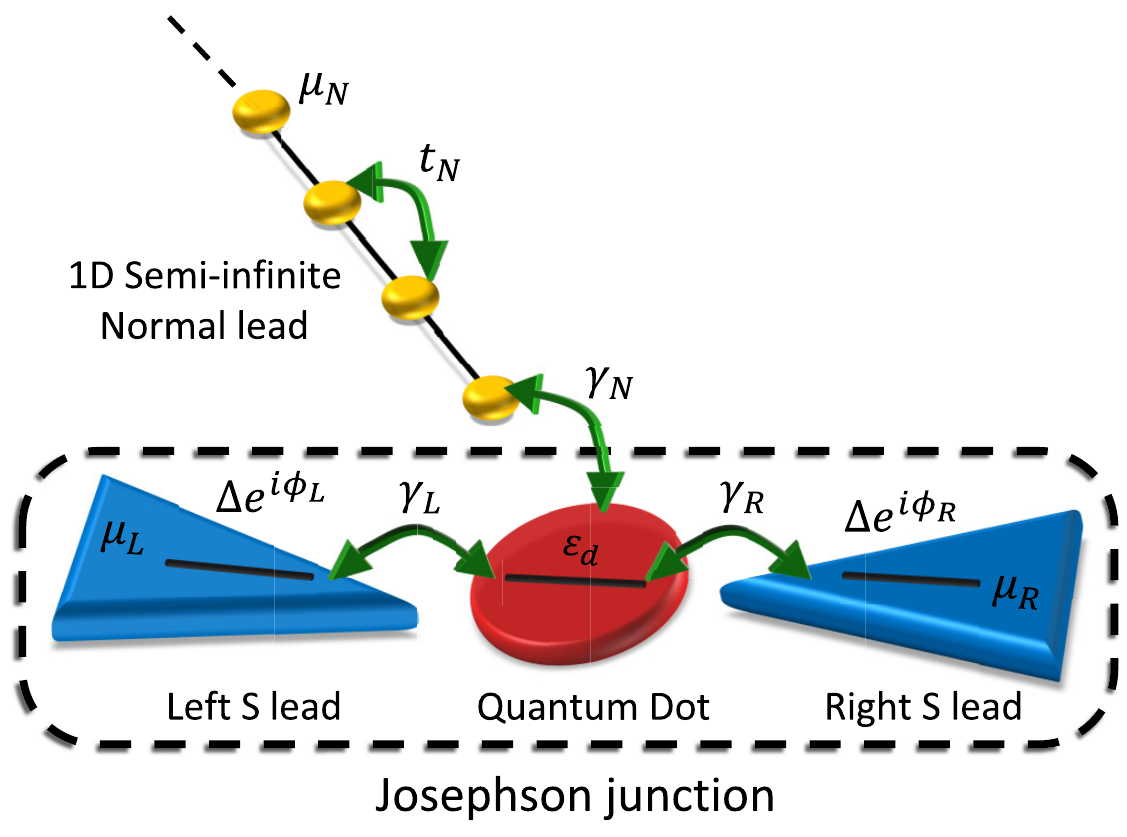
Josephson junctions (JJ) are superconducting devices -- made with aluminium or niobium or tantalum, etc. --
where some energy states are well separated from
the other energies. Separation means that a good control may be achieved, in particular, to encode qubits. In transmonic devices
qubit coherence times can execeed hundreds of microseconds but longer times are needed to achieve robust quantum computing and storage.
I studied the effect that a metallic substrate of a JJ has on the dissipation of the current flowing across the device. Dissipation can be
described by Hamiltonian terms that induce non-Hermiticity, and in turns, complex energy levels. Non-Hermitian physics is been a hot
topic in optics and is nowadays gaining attention in condensed matter. Can the reachness and simplicity of non-Hermitian physics be exploited to engineer
JJ with peculiar and non-intuitive properties? Can coherence times be engineered using the dissipation itself? This are only some of the questions
that I am trying to answer.
RMT of mesoscopic systems
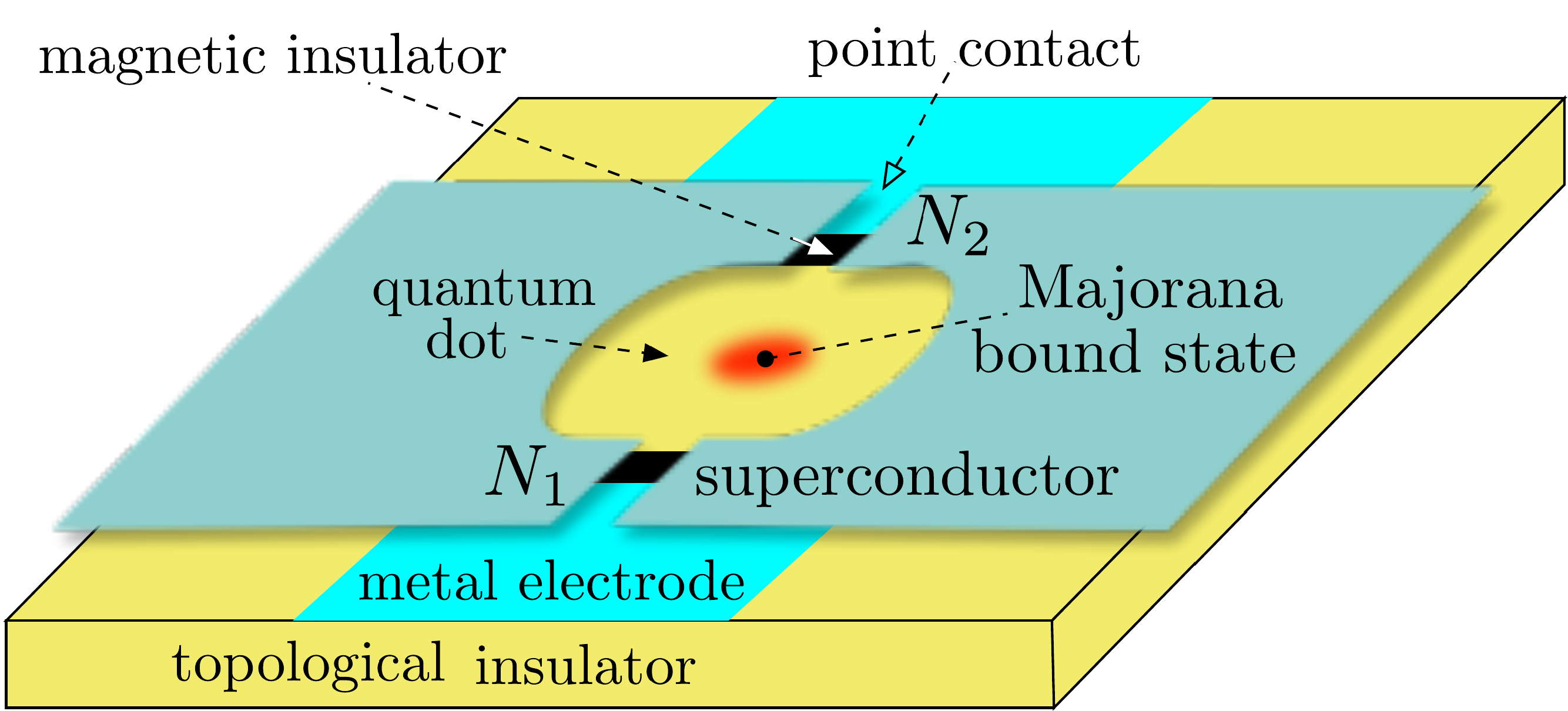
I devoted most part of the Ph.D. to the study of the random-matrix theory (RMT) for quantum dots
hosting unpaired Majorana states. Quantum dots are artificial atoms -- that is, with discrete energies -- that emerge at interfaces
between different electronic materials at micron and submicron level.
Majorana states are predicted to appear ...at the boundaries of topological superconductors
and they are of great interest for quantum computation. A couple of two spatially-separated unpaired Majorana states
can be used to encode a non-local qubit that is expected to be robust
against moderate imperfections of fabrication. Considering that the solid state community is putting a lot of efforts
in detecting such states, it is natural to ask which thermodynamic signatures of Majorana states
are likely to stay visible in a randomly disordered interface. Will the disorder wash out any signature of their presence?
Density of state, thermal conductance and thermopower are just
some of the quantities I studied in this context. Depending on the symmetries of the system,
in certain cases their probability distributions have been found to be strongly affected by the presence
(or absence) of Majorana unpaired states. A question has never been answered: can Majorana unpaired states be experimentally detected
in a probabilist way, by varying the disorder, building up hystograms of the measured thermodynamic quantities and comparing with
the prediction of RMT?
Artificial non-commutative crystals
Artificial crystals let us go beyond the contraints imposed by Chemistry.
They are systems with regular patterns but with atoms replaced by other artificial,
fundamental units, for instance circuit resonators or mechanical springs.
What typically moves inside these devices are bosonic particle modes (light, vibrations etc...),
and their behavior can display interesting Physics....
For instance, there have been experimental implementations of hyperbolic curved geometries which would be
impossible for natural crystals in our Euclidean space. Unfortunately, such implementations were quite awkward.
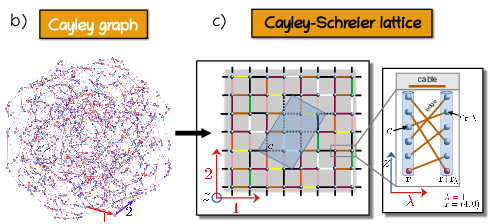
I contributed the topic showing that artificial crystals can be used to mimic the motion of electrons under
magnetic fields even though no magnetic field is applied from outside. What is more, several electrons
can be dropped in the lattice in such a way that they all bear a different magnetic field configuration.
And all of this generalizes to arbitrary gauge-fields while keeping the crystal architecture very scalable
and apt for experimental realizations. This is very exciting and goes in the direction of implementing
a full lattice gauge theory. Will it happen?